
Primary
Ages 3 to 6 years
"The real preparation for education is the study of one’s self." - Maria Montessori
The basic work of a child from ages 3-6 is self construction. Children possess an ability that Maria Montessori refers to as an “absorbent mind”. This stage occurs only during a specific time referred to as a sensitive period. Each sensitive period in the development of children readies the child to acquire the capabilities to construct the whole human they are meant to evolve into.
The prepared environment, which is the classroom, is constructed around five main areas each of which attract the interest of children and results in the acquisition of skills later to become the foundation of all education and personal fulfillment. Common to all areas, based on the belief of Maria Montessori, is that early learning comes through the senses; and more specifically, that our hands are the instruments for acquiring human intelligence.
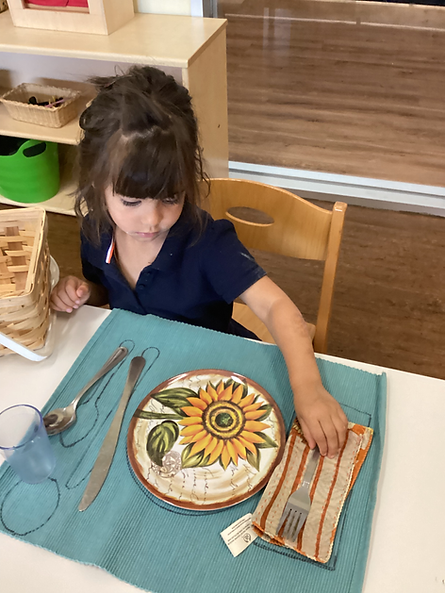
Practical Life
Five main areas are addressed in this part of the curriculum. They are: care of person, care of environment, control of movement, grace and courtesy.
The practical life area in the classroom will have work such as: pouring, transferring liquid or solids from one container to another, setting a table, arranging flowers, polishing silver, tying shoes, zipping zippers, walking quietly around the classroom, learning the language of etiquette at meals and working together etc. These particular pieces of work pattern themselves from real life skills needed in any real life environment. The activities are also preparation for use of more advanced Montessori materials in other areas in the classroom. These activities provide a sense of order and concentration resulting in the ability to take care on one self leading to feeling of confidence and self esteem.
Sensorial
Through the manipulation of a wide variety of materials for which each isolate a fundamental quality such as: color, form, dimension, texture, temperature, volume, pitch, weight, and taste, the child expands his/her ability to discern subtleties and appreciate the complexities and choices their world has to offer. Montessori tells us the senses, being explorers of the world, open the way to knowledge.


Language
Oral language is already well developed by the child at this time. It is enhanced via songs, games, poems, stories, and classified language cards.
Writing precedes reading and is facilitated through the use of sand paper letters using phonics as the approach. When a sufficient number of sounds are mastered the child then uses a movable alphabet to begin putting words, then phrases then sentences together. This is all preparation for reading.
Mathematics
The isolation of difficulties within the Montessori math materials is sequential and thorough. The child is led to the abstract by using the concrete materials which are beautiful glass beads and wooden symbols. This age child will cover the decimal system to 1000, become proficient in addition, subtraction, multiplication and division, skip count, understand the concept of cubing, by using many materials that reinforce the concepts in a variety of ways. This is one of the most developed and beautiful areas in the classroom and because each concept is presented through the use of different tools, all children find their own approach to understanding difficult and complex ideas. Memorization is not encouraged until a strong foundation of understanding is attained through manipulating concrete materials which fosters conceptual understanding rather than rote learning.


Cultural
(History, Geography, Botany)
The child as this age is self constructing. Learning about the world in the area of geography, continents, land and water forms, solar systems, living vs. non-living, plants, animals, water, matter, trees, flowers, life cycles, and nomenclature for a variety of systems assists the child to orient him/herself to the greater planetary realties and beyond. The goal of the cultural studies is to present an “impression”, rather than a scientific study, which enables the child to be awed, to be curious, and to be encouraged and excited to learn more about how they interface with the universe later in the elementary program.
Enrichment Program
-
Science – Hands-on experiments and exploration in a fully equipped discovery/science lab
-
Art – Creative projects that foster self-expression and fine motor skills
-
Music – Singing, rhythm, and exposure to instruments to develop musical appreciation
-
Spanish Language – Introduction to vocabulary, conversation, and cultural elements
-
Outdoor Gardening (Seasonal) – Planting, caring for, and observing the life cycle of plants
